
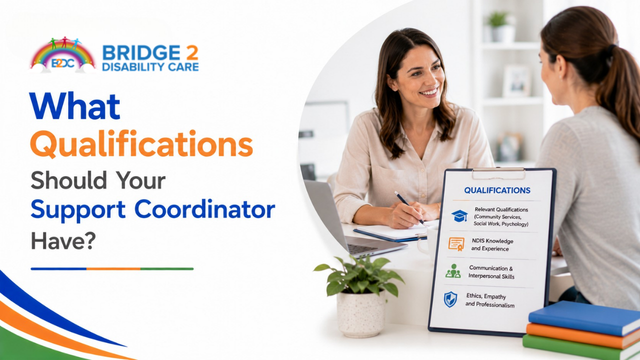
Choosing a Support Coordinator: More Than Just a Credential
You’ve decided you need a Support Coordinator to help manage your NDIS plan. But how do you know if the person you’re considering is actually qualified for the job? It’s a fair question. Your Support Coordinator will manage your funding, coordinate your providers, and play a key role in making your plan work for your life. You deserve someone with genuine expertise—not just a friendly face.
The challenge is that “Support Coordinator” isn’t a heavily regulated role in Australia. There’s no single mandatory qualification that everyone must hold. Instead, good Support Coordinators combine formal qualifications, relevant experience, and ongoing training. This guide breaks down what to look for.
The Formal Qualifications You Should See
Certificate IV in Disability (or Higher)
This is the baseline. A Certificate IV in Disability is a VET (vocational education and training) qualification that takes about 12 months to complete. It covers:
- How the NDIS works
- Person-centred planning
- Communication and coordination skills
- Understanding disability and person-centred support
- Workplace health and safety in disability support
A Support Coordinator with a Certificate IV has demonstrated understanding of disability support principles and NDIS fundamentals. Many disability support organisations require this as a minimum.
What to ask: “Do you have a Certificate IV in Disability or higher?” If they hesitate or don’t have this, ask what alternative qualifications they do hold.
Diploma of Disability (or Equivalent)
Several Support Coordinators hold a Diploma in Disability or Disability Services. This is a step above Certificate IV and typically involves:
- Advanced planning and coordination skills
- Deeper knowledge of NDIS policies and processes
- Communication with complex needs
- Peer support and mentoring
- Leadership and problem-solving in disability support
A Diploma holder brings broader knowledge and often more experience managing complex plans.
Bachelor’s Degree in Social Work, Counselling, or Related Field
Some Support Coordinators, particularly those running their own practices or working in senior roles, hold university degrees. Common degrees include:
- Bachelor of Social Work
- Bachelor of Health Sciences (Disability)
- Bachelor of Counselling
- Bachelor of Community Services
These qualifications add depth in understanding broader support systems, complex family dynamics, and long-term planning. They’re not required but often signal a Support Coordinator who’s invested significant time in their expertise.
The Experience You Should Look For
Qualifications are important, but experience matters equally. Here’s what matters in a Support Coordinator’s background:
Disability Support Experience (Minimum 2+ Years)
Your Support Coordinator should have spent time working directly in disability support. This might be:
- As a support worker: Actually working with people with disabilities in their homes or community, understanding the practical challenges
- In disability services: Managing or coordinating supports within a disability services organisation
- In NDIS environments: Previous experience navigating the NDIS system, understanding how it actually works (not just theory)
Why this matters: Someone who’s worked as a support worker understands the realities of disability. They know what can go wrong, what works well, and how to communicate with both service users and providers. Theoretical knowledge alone isn’t enough.
NDIS-Specific Experience
The NDIS is complex, and it changes regularly. A Support Coordinator with 3+ years of NDIS experience understands:
- How to navigate the NDIA’s systems
- Common issues that arise during implementation
- What funding typically covers across different disability types
- Local provider landscapes and relationships
- How to prepare for and manage plan reviews
Ask: “How long have you been working with NDIS participants?” Someone with 5+ years of NDIS experience has likely managed hundreds of plans and solved countless problems.
Experience With Your Disability Type
If you have a specific disability—autism, spinal cord injury, intellectual disability, psychosocial disability, physical disability—it’s valuable (though not essential) to work with someone who’s supported others with the same condition.
Why: Someone who’s supported multiple autistic NDIS participants, for example, understands the challenges, the types of services that work well, and the common issues. They can anticipate your needs and find solutions faster.
The Certifications and Registrations That Matter
NDIS Quality and Safeguards Commission Registration
If your Support Coordinator works through an organisation, that organisation should be registered with the NDIS Quality and Safeguards Commission. This means:
- They meet NDIS quality standards
- They’ve been background checked
- They have appropriate insurance
- They follow a code of conduct
- There’s a complaint mechanism if something goes wrong
You can check if an organisation is registered by searching the NDIS Finder tool or asking directly.
If your Support Coordinator is self-employed, they don’t legally have to be registered, but many choose to register as a “Support Broker” or similar. Ask what quality assurance processes they follow independently.
Professional Membership
Good Support Coordinators often hold memberships in professional bodies, such as:
- Australian Disability Workers Association: Signals commitment to professional standards and ongoing development
- Community Services and Health Industry Skills Council (CoINVEST): Professional development aligned with disability services
- State-based disability services associations: Shows engagement with the local sector
Membership isn’t mandatory, but it indicates someone who’s invested in professional development and staying current with best practice.
First Aid and CPR Certification
Most disability support professionals hold First Aid and CPR certification. While a Support Coordinator isn’t necessarily administering first aid, having this certification shows they take duty of care seriously and are prepared for emergencies.
Working With Children Check / Police Check
Any reputable Support Coordinator should have:
- A valid Working with Children check (if you have children or they work with children)
- A current police clearance / Working with Vulnerable People check
- Proof of these checks should be available on request
The Ongoing Training You Should Know About
Qualifications get outdated. The NDIS changes. Best practices evolve. A Support Coordinator worth their rate continues learning.
Annual NDIS Policy Updates
Ask: “How do you stay current with NDIS policy changes?” A good answer includes reading NDIA updates, attending webinars, or participating in industry forums. The NDIS changes regularly—new funding categories, process updates, policy shifts. Your Support Coordinator needs to be on top of these.
Disability-Specific Training
Good Support Coordinators take courses in their areas of focus, such as:
- Autism support and neurodiversity
- Psychosocial disability
- Spinal cord injury and complex physical support needs
- Intellectual disability and individualised planning
Ask what training they’ve done in the past 12 months.
Mental Health First Aid or Trauma-Informed Practice
If they work with people managing mental health, trauma, or psychosocial disability, training in Mental Health First Aid or trauma-informed practice adds significant value.
The Personal Skills That Matter Just as Much
Qualifications and credentials are one thing. But your Support Coordinator also needs:
Communication Skills
They need to:
- Explain complex NDIS policies in plain language
- Listen carefully to your goals and needs
- Communicate effectively with providers, the NDIA, and family members
- Write clear documentation and follow-up emails
- Handle conflict or disagreement constructively
You’ll know this in your first meeting. Do they explain things clearly? Do they ask good questions? Do they listen more than they talk?
Problem-Solving Ability
Plans don’t always go smoothly. A provider drops out. Funding falls short. Your needs change unexpectedly. Your Support Coordinator needs to:
- Stay calm under pressure
- Generate creative solutions
- Know who to contact for help
- Persist when the first option doesn’t work
- Think flexibly about how to achieve your goals
Ask about a complex situation they’ve managed. Listen for creative thinking, not just rule-following.
Reliability and Responsiveness
Your Support Coordinator should:
- Return calls and emails promptly (within 24-48 hours)
- Follow through on commitments
- Keep you updated on progress
- Be available during the times you need them
Ask them about their communication protocols before you hire them.
Cultural Sensitivity and Respect for Diversity
They should:
- Respect your values, culture, and beliefs
- Adapt their approach to your communication style
- Avoid judgment
- Celebrate your goals rather than imposing their own vision
This is harder to assess on a resume, but becomes clear in conversation. Do they ask about what matters to you, or do they assume?
Red Flags: What NOT to Accept
Some things should disqualify a Support Coordinator:
- No relevant qualifications or experience: If they can’t point to training or work history in disability support or the NDIS, that’s a problem
- No police or Working with Children check: This is non-negotiable for safety
- Vague about their approach: Good Support Coordinators can clearly explain how they work
- Overpromising results: If they guarantee outcomes or make unrealistic promises about NDIS funding or plan approvals, be cautious
- Poor references: Always ask for references and actually contact them
- Disorganised or unresponsive: If they’re hard to reach before you hire them, it won’t improve after
- Pressure to use particular providers: Good Support Coordinators find providers that work for you, not the other way around
- Unclear about fees: They should clearly explain how much they cost and what you’re paying for
What a Typical Interview Should Cover
When you meet with a potential Support Coordinator, ask:
- “What qualifications and training do you have in disability support and NDIS coordination?”
Listen for: Certificate IV or higher, NDIS-specific training, ongoing development - “How long have you been supporting NDIS participants?”
Listen for: 3+ years of direct NDIS experience - “Have you supported people with [your disability]?”
Listen for: Direct experience, and if not, willingness to learn and connect with specialists - “Tell me about a complex plan you’ve managed. What was the challenge and how did you solve it?”
Listen for: Problem-solving ability, persistence, creative thinking - “How often will we communicate, and how do you prefer to stay in touch?”
Listen for: Clear, structured communication plans; flexibility for your needs - “What happens if I’m unhappy with your service?”
Listen for: Open to feedback, clear complaint process, willingness to adjust approach - “Can you provide references from past clients or organisations you’ve worked with?”
Listen for: Willingness to provide references; strong relationships with other services
The Bottom Line
A qualified Support Coordinator should have:
✓ At minimum: Certificate IV in Disability (or equivalent) + 2+ years disability support experience + NDIS registration or clear quality assurance processes
✓ Ideally: Diploma or higher qualification + 3+ years NDIS-specific experience + experience with your disability type + ongoing professional development
✓ Always: Police clearance,Ndis clearance check strong communication, reliability, problem-solving ability, and genuine respect for your goals
✓ Check: Registration with NDIS Commission (if applicable), references, insurance, and working relationships with local providers
Qualifications matter, but they’re not the whole story. The best Support Coordinator combines formal credentials with real-world experience, strong communication skills, and a genuine commitment to helping you achieve your goals.
Take time to interview multiple candidates. Ask tough questions. Check references. Trust your gut. The right Support Coordinator can transform your NDIS experience from stressful to manageable and that’s worth the effort to find them.
Conclusion
Choosing the right Support Coordinator is one of the most important decisions you’ll make in your NDIS journey. Take time to find someone with the right mix of qualifications, experience, and personal skills. Your NDIS plan and your quality of life depends on having a partner you can trust and rely on.
If you’re in Perth and looking for professional, qualified support coordination, we’re here to help.
📞 Let’s Stay Connected
Looking for guidance on choosing the right Support Coordinator?
📧 info@bridge2disabilitycare.com.au
📞 08 6119 9696
🌐 bridge2disabilitycare.com.au
FAQ’s
1. Do Support Coordinators need to be registered?
If they work through an NDIS-registered organisation, yes. If they’re self-employed, they’re not legally required to be registered, but many choose to register as Support Brokers or similar. Ask what quality assurance they follow.
2. What’s the difference between a Support Coordinator and a Support Broker?
The terms are often used interchangeably. Some people use “Support Broker” to mean someone who’s independently registered. Both roles support NDIS plan implementation. The key difference is registration status, not the actual work.
3. Can I change Support Coordinators if I’m unhappy?
Yes, absolutely. You can give notice to your current Support Coordinator and begin working with someone else. Your plan can be adjusted during a review.
4. What if I can’t find a Support Coordinator with experience in my specific disability?
That’s common, especially for less common disabilities. Look for someone with strong NDIS experience, good problem-solving skills, and willingness to learn. You can help educate them about your specific needs.
5. Are there qualifications specific to Support Coordination?
There’s no single “Support Coordinator” qualification. People come to the role from various paths: support work, disability services management, social work, counselling and allied health service. This variety is normal.